Packaging machinery can move cartons quickly, guide film into place, and seal packages with heat. These tasks create familiar risks: pinch points, hot surfaces, sharp edges, unexpected starts, and repetitive reaching. A loose sleeve near a conveyor can become a hazard in seconds. Small gaps matter. The question, what safety considerations are important in packaging machinery, depends on the equipment, the product, and the work being done around it. A practical review should examine the whole line, not just the machine’s main moving parts.
This guide introduces seven areas to assess: effective guards and interlocks, accessible emergency stops, safe energy isolation during servicing, clear operating procedures, hands-on training, ergonomic workstation design, and routine inspections. For example, check whether a guard blocks access to a drive belt and whether operators can reach an emergency stop without crossing a moving conveyor. Confirm that cleaning and jam-clearing steps address stored energy, using the machine manufacturer’s instructions and qualified safety personnel as references. A checklist helps, but it cannot replace watching the line run during a real shift. People sometimes work around awkward controls or repeat small workarounds until they seem normal. That deserves a closer look. Conditions change when products, tooling, staffing, or production speeds change, so safety reviews should be revisited. The aim is not paperwork for its own sake; it is equipment and work practices that help prevent injury while keeping production tasks clear and manageable.
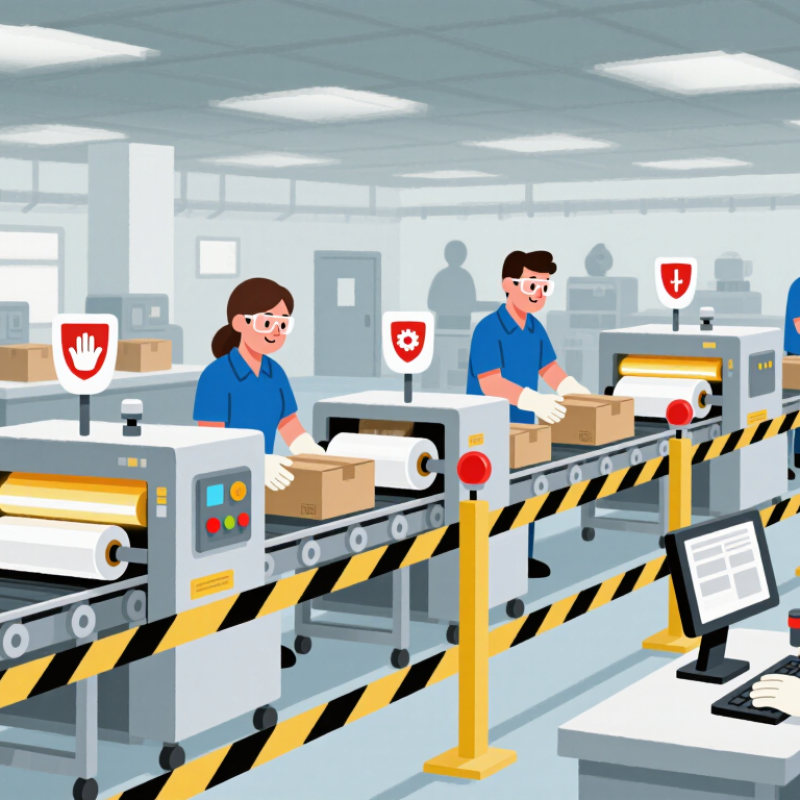
Assess Packaging-Line Risks Using the ISO 12100:2010 Framework
Packaging hazards often hide where products move: conveyor nip points, forming jaws, cutters, robot cells, and palletizers. ISO 12100:2010 calls for defining machine limits, identifying hazards, estimating and evaluating risk, then reducing it. Assess normal production, setup, cleaning, fault-finding, and jam removal. A guard that works during production may be opened during changeover.
Look closely at access doors, interlocks, emergency stops, unexpected restart, stored pneumatic energy, and manual lifting. Observe operators reaching around a guide rail or clearing a crumpled carton; these details can expose risks that drawings miss. The U.S. Bureau of Labor Statistics reported 2.8 recordable injury and illness cases per 100 full-time manufacturing workers in 2023. That industry-wide figure is not a packaging-line risk estimate, but it shows why machine hazards deserve careful attention.
ISO 12100 prioritizes inherently safer design, followed by safeguards and clear user information. Consider slower safe settings, fixed or interlocked guards, and verified energy isolation during maintenance. Test safeguards in real operating conditions, including awkward changeovers. Involve operators and maintenance staff. Risk worksheets can look tidy; the machine floor is not. Revisit the assessment after layout changes, recurring jams, or near misses, and document remaining risks plainly. A missed access point can undermine an otherwise solid design.
| Safety consideration | Typical packaging-line hazards | ISO 12100:2010 assessment focus | Risk-reduction measures | Verification and review |
|---|---|---|---|---|
| 1. Identify hazards across the machine life cycle | Crushing, shearing, drawing-in, cutting, hot surfaces, electrical energy, unexpected movement, noise, and hazards from cleaning, setup, fault-finding, maintenance, or dismantling. | Define the machine limits, intended use, reasonably foreseeable misuse, tasks, users, and life-cycle phases. Identify hazards, hazardous situations, and hazardous events for each task. | Include operators, setters, cleaners, maintenance personnel, and contractors in task reviews. Examine normal production and non-routine work, including jams and changeovers. | Maintain a task-based hazard list and update it after machine changes, incidents, near misses, or changes to materials, products, or operating procedures. |
| 2. Prevent access to moving and hazardous parts | Access to conveyors, infeed screws, rollers, belts, chains, cutters, forming tools, seal jaws, palletizers, and robot cells can expose people to entanglement, impact, or crushing. | Estimate risk by considering possible injury severity and the probability of harm, including exposure, occurrence of a hazardous event, and the possibility of avoiding or limiting harm. | Use inherently safer design where practicable, such as reducing accessible nip points. Apply fixed guards or interlocked movable guards where access is needed; use presence-sensing protective devices where appropriate to the risk and task. | Check guard strength, coverage, openings, mounting, and access points. Verify that interlocks and protective devices function as intended and cannot be easily defeated. |
| 3. Control access during setup, cleaning, and jam clearing | Workers may reach into machinery to remove rejected packs, clear film or cartons, clean product-contact areas, or adjust tooling while hazardous motion or stored energy remains. | Assess each intervention separately from normal automatic operation, including how often it occurs, how long exposure lasts, and whether the task can be completed without entering a danger zone. | Design for safe access and reduce the need to reach into danger zones. Where access is necessary, use suitable protective measures and task-specific isolation procedures; do not rely on a stop button as energy isolation. | Observe the actual task in production conditions. Confirm that instructions, tools, access routes, and protective measures work for foreseeable interventions. |
| 4. Isolate hazardous energy before servicing | Electrical power, pneumatic or hydraulic pressure, gravity, springs, hot sealing equipment, and stored mechanical energy can cause unexpected startup or release of energy. | Identify all energy sources and hazardous states, including residual or stored energy, and assess the risks associated with isolation, verification, and restoration of power. | Provide accessible isolation points that can be secured against reconnection. Design for safe dissipation or restraint of stored energy and provide a means to verify a zero-energy state before work begins. | Test isolation and energy-dissipation arrangements under defined procedures. Ensure energy-source labels and maintenance instructions correspond to the installed machine. |
| 5. Design safe controls, stops, and restart behavior | Unexpected startup, incorrect mode selection, confusing controls, inaccessible emergency stops, or automatic restart after a power interruption can create hazardous situations. | Assess foreseeable control-system faults and operating errors in relation to the required risk reduction. Consider start, stop, reset, mode selection, and changes between manual and automatic operation. | Use clearly identified controls and suitable mode selection. Ensure reset actions do not themselves initiate hazardous motion, and prevent unexpected restart where it could expose people to risk. Provide emergency stops where required by the risk assessment. | Validate control and safety functions against the design specification, including fault conditions and restart behavior. Check that emergency-stop devices are accessible and do not replace guarding or isolation. |
| 6. Address ergonomics and human interaction | Repetitive loading, awkward reaches, heavy rolls or tooling, poor visibility, slippery floors, and high noise can contribute to injury, error, or unsafe workarounds. | Include human factors in the assessment: task frequency, posture, effort, visibility, reach, information presentation, and the interaction between people and automated equipment. | Arrange controls and work areas for clear access and visibility. Reduce manual handling demands where practicable, provide suitable handling aids, and use clear labels and instructions for operating modes and hazards. | Review representative tasks with intended users. Reassess after changes to staffing, work pace, product format, workstation layout, or production sequence. |
| 7. Apply the risk-reduction hierarchy and document the result | Residual hazards may remain after design and safeguarding, including risks during maintenance, access, adjustment, or use of auxiliary equipment. | Follow the ISO 12100 sequence: inherently safe design measures first, safeguarding and complementary protective measures second, and information for use for residual risk. Repeat assessment after each measure. | Do not use warnings or training as a substitute for feasible design measures or safeguards. Provide instructions, warnings, and residual-risk information for hazards that cannot be eliminated or sufficiently reduced by design and protective measures. | Record hazards, risk estimates, selected measures, and validation evidence. Reassess when the machine, process, intended use, or relevant operating conditions change. |
Assessment note: ISO 12100:2010 provides a risk-assessment and risk-reduction methodology; it does not prescribe one universal numerical scoring system or fixed acceptable-risk score. The assessment should be specific to the machine, tasks, users, and operating conditions.
Assess production, setup, cleaning, fault-finding, and jam removal. A guard may be open during a hurried changeover.
Check conveyor nip points, forming jaws, cutters, robot cells, and palletizers. Watch for hands reaching around guide rails or crushed cartons.
Prefer safer machine design, then use safeguards and clear instructions. Consider slower safe settings, fixed guards, interlocks, and verified energy isolation.
Risk assessment sets the target for each safety function. The full control path matters, from sensor through logic to switching device.
Test faults, maintenance tasks, and awkward changeovers. A neat calculation can miss a cramped access point.
Follow the documented test procedure. Confirm stops work, guards prevent hazardous motion, and reset does not cause unexpected restart.
Record the machine, device, date, inspector, result, and follow-up action. Keep it honest. A tick mark alone may hide a rushed test.
Remove the machine from service until qualified personnel repair it. Do not bypass the device to maintain production.
Review it after layout changes, recurring jams, or near misses. The machine floor may reveal what drawings missed.
Understanding what safety considerations are important in packaging machinery starts with identifying hazards throughout the production line. A structured risk assessment can help teams spot dangers such as moving parts, pinch points, unexpected starts, and access to hazardous areas. Appropriate guards should prevent contact with dangerous machine points while allowing routine operation and maintenance to be carried out safely.
Safety controls should be selected and designed to match the level of risk, including reliable interlocks and emergency stops where needed. Before maintenance or clearing a jam, workers should isolate energy sources and verify that machinery cannot restart unexpectedly. Regular, documented inspections can confirm that guards, emergency stops, and interlocks function as intended. Clear procedures, staff training, and prompt correction of defects help make safety a consistent part of daily packaging-line operations.

 Switara Packing